


- Details

Photo Source: Wikimedia Commons, Kelsey Rideout
The Prehistoric, Primitive Przewalski Pony
Unraveling a Whoppin' Yarn of Evolution
By Rebekah L. Holt
“Molecule-to-Mare” evolution permeates the equestrian circle well beyond the face value of Darwin’s infamous horse series. Pull the thread of the imaginary evolution of the horse and you’ll unravel a clever tapestry of myths that are accepted and integrated into the modern horse world.
The Przewalski and Evolutionary Propaganda
 Photo by Wikipedia Nikolai Przewalski |
The Przewalski horse (a.k.a. Asian Wild Horse and tahki/tahk) is a rugged, exotic breed native to Mongolia and has been kept from extinction by conservation efforts. Much of the Przewalski's history is vague, opening the door for speculation. According to the International Museum of the Horse (IMH), these horses were "discovered only in the last century”1by a Russian military officer, Nikolai Mikailovich Przewalski. Still, Przewalski horses are frequently noted as the sole survivors of the primitive trio that is “held to be the foundation of today's equine races."2 The IMH website claims that this rugged breed is "the oldest horse still in existence" and that "it is believed to be a direct or collateral ancestor of all living breeds."1 |
Various media sources write that the Przewalski horse is the only living breed that is genuinely wild.
"The Przewalski horse - takh in Mongolian - is the sole surviving genuine wild horse in the world, not to be confused with, for instance, the mustang, a descendent from domestic breeds gone wild. The takh is the only wild relative of the domestic horse that has been able to hold out during the cause of natural history."3[emphasis mine]
 Przewalski Horse by Wikimedia, 4028mdk09 J. Tserendeleg, president of the Mongolian Association for Conservation of Nature and the Environment, is quoted on The American Museum of Natural History's website:
"The takhi is the only surviving wild horse left on earth."4
Horse encyclopedias declare that the Przewalski also sports “primitive” physical characteristics. The breed's trademark dun (tan) coloring with dark dorsal stripe and leg markings are classified as "typically primitive"5 while their coarse, upright manes are "a notable 'primitive' feature." 6
Origin of Prehistoric and Primitive Claims
Excavating through these claims of primitive origin, we discover that the “knowledge” of the Przewalski’s “ancient heritage” begins with the cave paintings, engravings, and artifacts found throughout the rocky regions of Europe. As an example, the Lascaux cave in France is upheld by IMH to depict the modern Przewalski on its walls.
"The modern Przewalski horse resembles many of the animals appearing in the cave paintings at Lascaux, France."7
Such discoveries are dated 20,000-9,000 BC8 though some scientists have dated these paintings up to 30,000 years.9
Dating Problems with Prehistoric Przewalski Paintings
Evolutionists rely on the horse drawings in the caves to give ancient dates to modern horse types. The cave of Lascaux website tells how the paintings are dated:
"The research carried out during the past decades has placed the iconography of Lascaux at the beginning of the Magdalenian Age, that is, 17,000 years before today. However, certain indications, both thematic and graphic, suggest that certain figures could belong to a more recent period. This is borne out by dating with Carbon 14 (around 15,000 years old)."10
Carbon dating is unpredictable in giving accurate ages. This dating method relies on the amount of carbon-14 found in the substance tested. Due to possible environmental changes and the living organism's absorption of carbon 14, many discrepancies declare this dating method to be a “pick your own age” type of system. In fact, modern fossils of known ages have been carbon tested to be thousands of years older than they really are! (To learn more about Carbon Dating, click here)
Przewalski’s Not a Solo Horse Painting

Photo by Lascaux: Discover |
It is true that some of the horses depicted resemble a chunky, dun colored pony like the Przewalski. Yet, there is a multitude of horses drawn or carved in a spectrum of colors: gray, black, yellow, red, brown, pinto, spotted, etc.― some found in the same caves! Many beautiful rock drawings, illustrate horses with elegant refinement, similar to the contemporary Thoroughbred and Arabian. From a website on Ice Age art, here is a description of one of the horse carvings found in the rock: |
"This is not, in fact, a realistic depiction of the Ice Age horse, which was a stocky, pony-like animal. Instead, it is a highly stylized image, the lines of which are perfectly expressive of the movement, grace, and speed of a horse."11
The horses are drawn at different statures, in various movements and are always spotlighted as if a favorite subject for the cave artists. To be consistent with the discovery, the diversity of horse rock drawings portrayed on the cavernous walls suggests equine variety at the time of illustration and sophisticated, 100% human artistry. (To learn more about sophisticated “cavemen," click here)
Primitive Phenotype
At a glance, the Przewalski's claim to primitive fame would be its distinctive wild appearance. The horses simply look rugged, rough, and roguish against the more refined, elegant domestic breeds popular among horsemen.
Much ado is made concerning the Przewalski’s upright, coarse mane, no forelock and dun coloring.13 However, such characteristics can hardly imply ancient ancestry. Instead they suggest a loss of genetic variation12 that would allow for a flowing mane, forelock, and a variety of coloring.
“Genetic drift and bottlenecks in the history of the captive population have resulted in the loss of some of the genetic diversity represented by the original founders.12
Upright Manes

No Forelocks
|
Photo by Gerald Durrell |
We could also question the claim of no forelocks for Przewalski horses. Forelocks are simply extensions of the mane down the front of the horse’s face. The forelock grows out of the hairline associated behind the ears and on top of the horse’s poll. Looking at pictures available, these horses have the same hairline as “domestic” horses. Yet, they do not have the forelock hair growth that allows for a forelock classification. |

Primitive Coloring
 Darwin's Horse, PDCharles Darwin considered the dun coloring to indicate primitive color for horses.
"Nevertheless the similarity in the most distinct breeds in their general range of colour, in their dappling, and in the occasional appearance, especially in duns, of leg-stripes and of double or triple shoulder-stripes, taken together, indicate the probability of the descent of all the existing races from a single, dun-coloured, more or less striped, primitive stock, to which our horses occasionally revert."14
However, scientific study of hair pigmentation and coat color genetics nullifies the concept of an anceint dun color. The study of equine hair pigmentation is entirely fascinating, declaring design and intelligence of a Creator God. Within the horse hair are microscopic pigment granules that contain the pigment melanin (this pigment comes in two forms, pheomelanin [yellow/red] and eumelanin [black]). These pigment granules are arranged like strings of pearls within the transparent hair shaft. The light reflecting off of the series of pigment “dots” determines the shade of color we see with the human eye. Total pigmentation of each hair granule offers a dense color, while slight pigmentation will reflect a lighter color.15
 |
 |
|
Microscopic Photographs of
Hair Pigment Granules15 1. Buckskin dun
2. Mouse dun 3. Seal brown |
Microscopic Photographs of
Hair Pigment Granules15 1. Palomino
2. Sandy bay 3. Black |
While there is much left to discover in understanding the dun coloring on a molecular level, equine geneticists believe that the gene responsible for the dun coat modifies or dilutes other color genetics.16 Such a genetic relationship suggests that many genes work together to produce the right formula for a tawny coat. According to evolution, we should expect a “primitive” color to stand on its own feet and not be modified by a series of complex color genes.
What Do We Know About The Przewalski's Heritage?
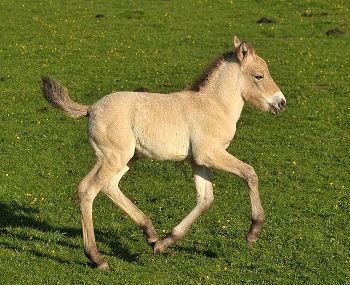 Photo Source: Wikimedia Commons, Michael Gabler
For the Christian equestrian who understands the historical accuracy and inerrancy of God's written Word (the Bible), answering the questions of the Przewalski's heritage is rather simple. The Bible states that the ancestors of all land dwelling animals were domesticated passengers of Noah's Ark (Genesis 6-8). Pairs of land dwelling animals were aboard the Ark of Noah approximately 4300-4500 years ago when God judged the world's sin with a global flood. The scriptures tell us that only after the Flood did God place the fear of man on the animals.17 Therefore, the ancestors of our horses were not wild survivors of millions of years of death and struggle, but the docile boarders of Noah's ark.
Even before Noah, the Bible records that the beginning of time took place only about 6000 years ago. The Creator God made the equus kind on the sixth day of the creation week. Mankind was also created on the sixth day, not as an ape, but fully human in the image of God.
Summary
The evolutionary claims made for the Przewalskis exist solely on man's fallible fabrication to "fit" evolutionists' need for a "prehistoric" visual aid. When carefully examined, what is truly known about the Przewalski is trifling and often contradictory.
"The debate surrounding the "purity" of Przewalski's horses…is a legendary subject in the literature of captive propagation and endangered species management and reintroduction. As is often the case, strongly held opinions are based on data that are subject to diverse interpretations…Recent genetic information suggests that the Przewalski's horse has far too close an affinity with domestic horses to be the primitive horse..."18
Truth seeking equestrians need only to pull the tale of Przewalski's horse to unravel a whoppin’ yarn of equine evolution. The fibers of Darwin's weave fray fast when measured by Truth's standard!
References:
[1] The International Museum of the Horse, The Legacy of the Horse: A Chronological History of Humans and Their Relationship with Horses, chap. 1A, http://www.imh.org/imh/kyhpl1a.html#xtocid2243612 December 18, 2006
[2] Edwards, Elwyn Hartley, The Encyclopedia of the Horse, Dorling Kindersley Publishing, Inc.,New York,NY, 1994, p. 18
[3] Foundation for the Preservation and Protection of the Przewalski Horse http://www.treemail.nl/takh/horse/index.htm >December 18, 2006
[4]The AmericanMuseum ofNatural History-BioBulletin, http://biobulletin.amnh.org/D/2/1/ ,January 1, 2007
[6] Edwards, Elwyn Hartley, The Encyclopedia of the Horse, Dorling Kindersley Publishing, Inc.,New York,NY, 1994, p. 19
[7] The International Museum of the Horse, The Legacy of the Horse: A Chronological History of Humans and Their Relationship with Horses, chapter 1A, http://www.imh.org/imh/kyhpl1a.html#xtocid2243612 , December 18, 2006
[8] Wakefield, Simon, et. al, “Status and Action Plan for the Przewalski’s Horse(Equus ferus przewalskii),” p. 83
[9] San Diego Zoo's Animal Bytes: Przewalski's Horse, http://sandiegozoo.org/animalbytes/t-przewalski_horse.html, December 18, 2006
[10] Lascaux: Discover, http://www.culture.gouv.fr/culture/arcnat/lascaux/en/f-dec.htm?&ba=f-visite.htm?+contenu=f-da.htm ;December 18, 2006
[11] http://www.amnh.org/exhibitions/expeditions/treasure_fossil/Treasures/Ice_Age_Art/iceage.html?cults , February 11, 2006
[12] The Przewalski horses that we observe today are products of captive breeding. Only twelve horses are the ancestors of the current population of approximately 1200 Przewalski. Conservationists share that genetic homology is a current threat to preserving the breed. “The long-term threat to the retention of heritable variation in the captive population is loss of founder genes. Sixty percent of the unique genes of the studbook population have been lost (Ryder 1994). Losses of founder genes are irretrievable and further losses must be minimized through close genetic management. Furthermore, inbreeding depression could become a population-wide concern as the population inevitably becomes increasingly inbred.” Wakefield, Simon, et. al, “Status and Action Plan for the Przewalski’s Horse (Equus ferus przewalskii),” p. 89
[13] Edwards, E., Ultimate Horse, Dorling Kindersley Publishing, Inc., New York, New York, p. 29, 2002
[14] Darwin, C. The Variation of Animals and Plants Under Domestication V1, Classic Literature Library, p. 41, December 18, 2006
[15] "There is but one pigment which produces color in hair of horses. The color or depth of color produced depends on the amount of pigment, the extent of clustering of the pigment granules, and the distribution of the pigment granules clusters…The color patterns are made up of hairs differently pigmented, and by different distributions of the pigment in the individual hairs. " Gremmel, Fred, "Coat Colors In Horses", The Journal of Heredity, 30(10):437-445, Oct 1939
[16] Bowling, Ann T., Ph.D., "Coat Color Genetics" Veterinary Genetics Laboratory, School of Veterinary Medicine, University of California, Davis, http://www.vgl.ucdavis.edu/~lvmillon/coatcolor/coatclr3.html#gened , January 1, 2007
[17] Genesis 9:2
[18] Historical Museum Specimens, Ancient DNA Studies, and the Origin of Przewalski's Horses, http://cres.sandiegozoo.org/projects/sp_przewalski_dna.html, December 18, 2006


